Brownian Hydrodynamics
In Brownian Hydrodynamics (BDHI) we reintroduce the hydrodynamic interactions neglected in Brownian Dynamics.
An stochastic differential equation for the time evolution of the positions of a collection of colloidal particles with positions  from the Smoluchowski description of the two-body level marginal probability [1] as

Where  are the forces acting on the particles (in UAMMD Interactors are used to provide forces) and the (so-called) Brownian motion,
  , is a collection of Wienner increments with zero mean and

The pairwise mobility tensor,  , encodes in its elements the hydrodynamic transfer of the force at one point
  , to the displacement at another point
  . It thus determines the correlations between two particle displacements.
The mobility tensor is then related to the diffusion coefficients via the Einstein relation,
. It thus determines the correlations between two particle displacements.
The mobility tensor is then related to the diffusion coefficients via the Einstein relation,

The Einstein relation coupled with the fluctuation dissipation balance (stating that, in the absence of forces,  ) hints that mobility tensor should be symmetric and positive semi-definite, so that we can define a tensor
  such that

If the system is translationally invariant (isotropic)  . To model hydrodynamic couplings, is usually taken to be the Rotne-Prager-Yamakawa tensor (describing up to the second hydrodynamic reflection) [1]. Including further reflections explodes the complexity of the formulation and it is only useful in situations in which particles are really close (e.g. high densities) [1], in which case the lubrication approximation is preferable.
Note
There are situations in which the system is not isotropic. Such is the case if a wall is present, where the mobility becomes dependent on the distance to the wall,  .
.
The last term in the BDHI equation of motion, known as the thermal drift term, can be non zero in cases where rigid particle constraints are imposed [2] or due to the presence of boundaries [3] [4]. However, in isotropic and irrotational hydrodynamic fields, this term is usually zero and can thus be omitted from the description.
Hint
In UAMMD, the Quasi 2D hydrodynamics module is the only solver that includes the thermal drift term explicitly.
One of the usual choices for the mobility tensor is the Rotne-Prager-Yamakawa (RPY) tensor [5] , describing the hydrodynamic interaction of two spheres of radius  . The free-space RPY mobility tensor can be written in real space as

The self mobility,  is, by no coincidence, equal to the drag for a sphere moving through a Stokesian fluid as given by the Stokes-Einstein relation [1].
Note
Most UAMMD hydrodynamic modules work at the RPY level, although the pseudo-spectral, immersed-boundary-like, algorithms offered by UAMMD (see for instance the Force Coupling Method) regularize the mobility slightly differently in the near field.
Hint
The distinction between BD and BDHI in this documentation (and therefore UAMMD) is a bit arbitrary. We call BD to the particular case of BDHI in which we neglect hydrodynamic interactions. This distinction is, however, useful for us due to the much more complex nature of the algorithms employed to solve BDHI (as opposed to the quite simple ones that our so-called BD allows). In the literature, both BDHI and BD are typically referred to as simply “BD”.
Given the, in general, long-ranged nature of the hydrodynamic interaction numerical integration of the BDHI equations is not trivial (and quite the field on its own). The main difficulties are related to evaluating the  product (a
  operation in principle) and the square root of the mobility for the thermal fluctuations (an even more complex operation). Different algorithms exists depending on the boundary conditions and the geometry of the domain. UAMMD offers hydrodynamic solvers (in the form of Integrators) for open, triply periodic and doubly periodic boundary conditions.
- It is worth summarizing them here:
Triply periodic: Force Coupling Method, Positively Split Ewald, Fluctuating Immersed Boundary.
Doubly periodic: Quasi two-dimensional, Doubly Periodic Stokes (DPStokes).
Let us start with the open boundary solvers.
Open boundary BDHI solvers
Cholesky
The classic strategy for computing the square root of the mobility, originally proposed by Ermak [6], is by direct Cholesky factorization. This operation requires  operations, rendering this algorithm unsuitable for large numbers of particles (above
  ). Additionally, it has storage requirements, since the full mobility matrix has to be stored.
However, the sheer raw power of the GPU can make this a valid option. In UAMMD the Cholesky factorization is accomplished via a single library call to NVIDIA’s cuSolver function potrf.
On the other hand, since the mobility matrix has to be stored anyway, the rest of the algorithm can be coded via a few function calls to a linear algebra library. In particular, the Cholesky module uses the matrix-vector multiplications in the cuBLAS library. Taking into account the symmetric form of the mobility matrix, only the upper half needs to be computed and stored, cuBLAS (and most linear algebra libraries) provide subroutines that leverage this. In this regard, there is not much possibility for optimization.
). Additionally, it has storage requirements, since the full mobility matrix has to be stored.
However, the sheer raw power of the GPU can make this a valid option. In UAMMD the Cholesky factorization is accomplished via a single library call to NVIDIA’s cuSolver function potrf.
On the other hand, since the mobility matrix has to be stored anyway, the rest of the algorithm can be coded via a few function calls to a linear algebra library. In particular, the Cholesky module uses the matrix-vector multiplications in the cuBLAS library. Taking into account the symmetric form of the mobility matrix, only the upper half needs to be computed and stored, cuBLAS (and most linear algebra libraries) provide subroutines that leverage this. In this regard, there is not much possibility for optimization.
Usage
In UAMMD, BDHI algorithms are separated between temporal integration schemes and strategies for computing the deterministic and stochastic displacements. Both pieces are joined to form an Integrator that can be used as usual. Here is an example of the Euler-Maruyama integration scheme being specialized with the Cholesky decomposition algorithm for the fluctuations.
The following parameters are available:
real temperatureTemperature of the solvent in units of energy. This isin the formulas.
real viscosityViscosity of the solvent.
real hydrodynamicRadiusHydrodynamic radius of the particles (same for all particles*)
real dtTime step
* If this parameter is not provided, the module will try to use the particle’s radius as the hydrodynamic radius of each particle. In the latter case, if particle radii has not been set in ParticleData prior to the construction of the module an error will be thrown.
#include"uammd.cuh"
#include<Integrator/BDHI/BDHI_EulerMaruyama.cuh>
#include<Integrator/BDHI/BDHI_Cholesky.cuh>
using namespace uammd;
int main(){
  //Assume an instance of ParticleData, called "pd", is available
  ...
  //A strategy is mixed with an integration scheme
  using BDHI = BDHI::EulerMaruyama<BDHI::Cholesky>;
  BDHI::Parameters par;
  par.temperature = 1.0;
  par.viscosity = 1.0;
  //For Cholesky the radius is optional.
  //If not selected, the module will use the individual
  //  radius of each particle.
  //par.hydrodynamicRadius = 1.0;
  par.dt = 0.01;
  auto bdhi = std::make_shared<BDHI>(sim.pd, par);
  ...
  auto bdhi = make_shared<BDHI>(pd, par);
  ...
  //Add any interactor
  bdhi->addInteractor(myInteractor);
  ...
  //Take simulation to the next step
  bdhi->forwardTime();
  ...
  return 0;
}
Here, pd is a ParticleData instance.
Hint
Being an open boundary solver, Cholesky does not require a simulation box as a parameter.
Note
Cholesky uses a generalized form of the RPY tensor that accounts for differently sized particles, if an hydrodynamic radius is not provided, the radius in ParticleData will be used for each particle.
Note
As usual, any Interactor can be added to this Integrator, as long as it is able to compute forces.
Lanczos
Fixman proposed a method based on Chebyshev polynomials [7] to compute the square root of the mobility. This method requires approximating the extremal eigenvalues of the mobility. Many strategies can be employed to find out these eigenvalues, with complexities ranging from (thus beating the purpose) to  . More recently, a family of iterative algorithms based on Krylov subspace decompositions (using the Lanczos algorithm) have emerged [8] showcasing algorithmic complexities in the order
  , being
  the number of required iterations (which is usually around the order of
  depending on the desired tolerance). In uammd the technique developed in [8] is implemented.
Note
The Lanczos iterative algorithm for fast computation of  (being an arbitrary matrix and
  an arbitrary vector) is also available as a separate repository here https://github.com/RaulPPelaez/LanczosAlgorithm
Another benefit of this method over Cholesky is that it is not required to store the full mobility matrix in order to compute the fluctuations. The product of the mobility tensor by a vector (the forces in the deterministic term and a random noise in the fluctuating one) can be computed by recomputing the necessary terms. This will be particularly useful later, when most elements in the mobility tensor become zero, reducing the complexity of the computation for both terms. In particular, UAMMD’s implementation of the Lanczos iterative method is templated for any object capable of providing the product of any given vector with the mobility matrix. In the current instance we use the NBody algorithm coupled with a Transverser because the mobility is a dense matrix.
Usage
Using the Lanczos strategy in UAMMD is similar to using Cholesky. With the difference that now, being an iterative algorithm, a tolerance can be selected.
The following parameters are available:
real temperatureTemperature of the solvent in units of energy. This is
real viscosityViscosity of the solvent.
real hydrodynamicRadiusHydrodynamic radius of the particles (same for all particles*)
real dtTime step
real toleranceTolerance for the Lanczos iterative solver.
* If this parameter is not provided, the module will try to use the particle’s radius as the hydrodynamic radius of each particle. In the latter case, if particle radii has not been set in ParticleData prior to the construction of the module an error will be thrown.
#include"uammd.cuh"
#include<Integrator/BDHI/BDHI_EulerMaruyama.cuh>
#include<Integrator/BDHI/BDHI_Cholesky.cuh>
using namespace uammd;
int main(){
  //Assume an instance of ParticleData, called "pd", is available
  ...
  //A strategy is mixed with an integration scheme
  using BDHI = BDHI::EulerMaruyama<BDHI::Lanczos>;
  BDHI::Parameters par;
  par.temperature = 1.0;
  par.viscosity = 1.0;
  //For Lanczos the radius is optional.
  //If not selected, the module will use the individual
  //  radius of each particle.
  //par.hydrodynamicRadius = 1.0;
  par.dt = 0.01;
  //The tolerance for the stochastic term computation
  par.tolerance = 1e-3;
  ...
  auto bdhi = make_shared<BDHI>(pd, par);
  ...
  //Add any interactor
  bdhi->addInteractor(myInteractor);
  ...
  //Take simulation to the next step
  bdhi->forwardTime();
  ...
  return 0;
}
Here, pd is a ParticleData instance.
Hint
Being an open boundary solver, Lanczos does not require a simulation box as a parameter. Additionally, since this is an (approximate) iterative solver, a tolerance is also required.
Note
Lanczos uses a generalized form of the RPY tensor that accounts for differently sized particles, if an hydrodynamic radius is not provided, the radius in ParticleData will be used for each particle.
Note
As usual, any Interactor can be added to this Integrator, as long as it is able to compute forces.
Triply periodic BDHI solvers
UAMMD’s triply periodic solvers are based on solving the fluctuating steady Stokes equation for a fluid coupled with a group of particles (as opposed to the BDHI dynamical equation above). We wont go into much detail here, a more in depth description of the mathematical machinery behind these methods is provided, for instance, in [10] or [11]
If we take the overdamped limit of Navier-Stokes equation, where the momentum of the fluid can be eliminated as a fast variable (allowing to neglect the transient term  as well as the convection) we get the so-called Stokes equations
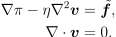
Where  represents the velocity field of the fluid,
  the pressure and
  its viscosity.
 includes the external forces,
  , (some localized force density acting on the fluid (which can arise from the presence of submerged particles)) and the thermal noise, which includes a fluctuating stress tensor,
  , which must comply with the fluctuation-dissipation balance according to the following statistical properties

Where  represent the different coordinates.
We can eliminate the pressure from the description by using the projection method. Let’s take the divergence of the first equation
![\eta\nabla^2\vec{\fvel} = \nabla\left[\nabla^{-2}(\nabla\cdot\tilde{\vec{f}})\right] - \tilde{\vec{f}} = -\oper{P} \tilde{\vec{f}}](../_images/math/587945a0d14f1439468cdd252f431b90e4147d15.svg)
Where the projection operator,  , is formally defined as

projects onto the space of divergence-free velocity.  represents the identity.
In the particular case of an unbounded domain with fluid at rest at infinity, all the differential operators in commute in Fourier space, so that
represents the identity.
In the particular case of an unbounded domain with fluid at rest at infinity, all the differential operators in commute in Fourier space, so that
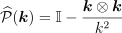
Where  are the wave numbers.
Finally, we can identify
are the wave numbers.
Finally, we can identify

as the Stokes solution operator to arrive at

The Green’s function,  , of this equation in the case of an unbounded domain can be written in Fourier space as

The inverse transform of this Green’s function can be computed analytically to get
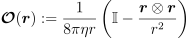
This solution is known as the Oseen tensor, the response of a three dimensional unbounded fluid at rest at infinity to a delta forcing.
The Green formalism laid out here constitutes a mechanism to translate forces into velocities in the fluid. In order to couple this with a group of submerged particles we make use of the Immersed Boundary Method (IBM).
The IBM teaches us that we can transform the forces acting on a group of particles into a force density of the fluid by making use of the spreading operator,  , as
, as

where  are the forces acting on the particles and
  is a distribution of compact support (usually a smooth smeared delta function, such as a Gaussian).
On the other hand, we can evaluate the velocity of a submerged particle by averaging its local fluid velocity (imposing a no-slip condition so that the particle follows the fluid exactly). We do this via the use of the interpolation operator,  , as
, as

where  is the velocity of particle
  .
.
Putting it all together, we can write the equation for the particle dynamics as

Which can be shown to be equivalent to the BDHI equations of motion for the particles by defining

or without the operator notation, the element mobility between particle and  as
as

Note
The RPY tensor arises from evaluating the double convolution of the Oseen tensor with a delta function integrated over the surface of two spheres centered at and .
Finally, its “square root” can be defined as

Force Coupling Method
The Force Coupling Method [9] is an Immersed-Boundary-like Eulerian-Lagrangian pseudo-spectral method initially devised for the computation of the hydrodynamic displacements of a colloidal suspension in a triply periodic environment. The FCM framework makes use of the Green formalism laid out in the previous section and constitutes the basis of all the other hydrodynamic modules in UAMMD.
Hint
The FCM is so generic as a Green formalism solver that UAMMD uses it also for electrostatics (see Electrostatics).
UAMMD’s open boundary hydrodynamic methods use the explicit form of an open boundary mobility (the RPY one), not taking into account the periodic images of the system in any way. Furthermore, the computational complexity of these methods is restrictive. Luckily, we can manage to do it in  operations if we consider periodic boundary conditions. In particular by solving the Stokes equation equation directly in Fourier space via the Force Coupling Method [9]. In doing so, we get the added benefit (and disadvantage) of not imposing a specific mobility tensor, which will arise naturally according to the convolution between the Green’s function and the spreading kernel.
We discretize and solve the velocity of the fluid on a regular grid with size  (which can vary in each direction), with a number of cells in each size
  .
We use the FFT to discretize the Fourier transform, this requires us to evaluate the properties of the fluid in a grid. This grid must be fine enough to correctly describe the smeared delta function (in the spreading and interpolation operators, a Gaussian in the case of the original FCM). On the other hand, the Gaussian kernel has an infinite range and to make the overall spreading/interpolation have a constant cost for each particle (independent of the size of the domain) it is necessary to truncate it at a certain distance,
.
We use the FFT to discretize the Fourier transform, this requires us to evaluate the properties of the fluid in a grid. This grid must be fine enough to correctly describe the smeared delta function (in the spreading and interpolation operators, a Gaussian in the case of the original FCM). On the other hand, the Gaussian kernel has an infinite range and to make the overall spreading/interpolation have a constant cost for each particle (independent of the size of the domain) it is necessary to truncate it at a certain distance,  . UAMMD automatically chooses these parameters to ensure errors stay below a certain provided tolerance.
- Without going into much detail, the FCM can be summarized into the following steps:
Spread particle forces to the grid:

Transform fluid forcing to Fourier space:

Multiply by the Green’s function to get

Sum the stochastic forcing in Fourier space:

Transform back to real space:

Interpolate grid velocities to particle positions:

Here  represents the Fourier transform operator.
Once the particle velocities are computed, the dynamics can be integrated using, for instance, the Euler-Maruyama scheme devised for Brownian Dynamics. The update rule in the case of Euler-Maruyama is

where the particle velocities already include the stochastic displacements.
Usage
Use as the rest of the Integrator modules.
The following parameters are available:
real temperatureTemperature of the solvent in units of energy. This is
real viscosityViscosity of the solvent.
real hydrodynamicRadiusHydrodynamic radius of the particles (same for all particles)
bool adaptBoxSize = falseIf set to true and the hydrodynamic radius is provided, the box size will be adapted to enforce the provided hydrodynamic radius;
int3 cellsNumber of grid cells in each direction. This parameter can be set instead of the hydrodynamic radius and will force FCM to construct the grid of this size.
real dtTime step
real toleranceOverall tolerance of the solver (affects the grid size and kernel support).
Box boxABoxwith the domain size information.
#include"uammd.cuh"
#include<Integrator/BDHI/BDHI_EulerMaruyama.cuh>
#include<Integrator/BDHI/BDHI_FCM.cuh>
using namespace uammd;
int main(){
  //Assume an instance of ParticleData, called "pd", is available
  ...
  //A strategy is mixed with an integration scheme
  using FCM = BDHI::EulerMaruyama<BDHI::FCM>;
  FCM::Parameters par;
  par.temperature = 1.0;
  par.viscosity = 1.0;
  par.hydrodynamicRadius = 1.0;
  //par.cells = {128, 128, 128}; //You can specify the grid size instead.
  par.dt = 0.01;
  par.tolerance = 1e-3;
  par.box = Box({128, 128, 128});
  auto bdhi = std::make_shared<FCM>(pd, par);
  ...
  //Add any interactor
  bdhi->addInteractor(myInteractor);
  ...
  //Take simulation to the next step
  bdhi->forwardTime();
  ...
  return 0;
}
Here, pd is a ParticleData instance.
Hint
Being a triply periodic solver, FCM requires a simulation box as a parameter. Additionally, since this is a non-exact solver (with spatial discretization errors), a tolerance is also required.
Warning
Contrary to the open boundary methods, in FCM all particles must have the same hydrodynamic radius.
Note
As usual, any Interactor can be added to this Integrator, as long as it is able to compute forces.
Hint
Although by default the Gaussian kernel is used for spreading/interpolation, the code includes a lot of other alternatives (such as Peskin kernels) that can be selected in the source file “Integrator/BDHI/BDHI_FCM.cuh”
Note
Although this is undocumented at the moment, the FCM module can also deal with torques/angular displacements.
Hint
Since FCM requires to bin the domain and the hydrodynamic radius is tied to the bin size, in general we cannot enforce both the domain size and the hydrodynamic radius at the same time. This is why the adaptBoxSize parameter exists. If the default heuristics for handling the cell dimensions are not satisfactory for you use case, you can always specify every parameter yourself (cell dimensions, kernel support and width, etc).
Hint
Note that the tolerance parameter is ignored depending on the kernel. For instance, the Peskin::threePoint kernel cannot be tweaked for some accuracy or another, the grid size will always be such that h = hydrodynamicRadius and the support is always 3 points.
Advanced functionality
The FCM Integrator relies on an underlying module called uammd::BDHI::FCM_impl. This class does not rely on any UAMMD base module (i.e. Integrator, ParticleData, etc), so it can be easily adapted to usage outside the UAMMD ecosystem.
-
template<class Kernel, class KernelTorque>
class BDHI::FCM_impl This class computes the hydrodynamic displacements of a suspension of equally-sized particles in a triply periodic domain, following the algorithm described in Force Coupling Method. It can be specialized for any Immersed Boundary Method-compatible kernel for both the linear (
Kernel) and dipolar (KernelTorquedisplacements).-
FCM_impl(Parameters par);
The constructor takes an instance of the
Parametersstruct defined insideFCM_impl. See the usage example below for a list of parameters.
-
real getSelfMobility();
Returns the self mobility that should be expected given the current parameters. This includes periodic corrections and the actual hydrodynamic radius in use.
-
std::pair<cached_vector<real3>, cached_vector<real3>> computeHydrodynamicDisplacements(real4 *q, real4 *F, real4 *T, int numberParticles, real kT, real b, cudaStream_t st = 0);
Computes the hydrodynamic displacements, defined as
 .
The positions,
.
The positions, q, the forces,Fand the torques,T, must be passed as pointers toreal4with interleaved x,y,z components for each marker. The fourth element is unused. The return type is a pair containing two gpu containers. The first element holds the linear displacements, while the second holds the dipolar displacements.
-
FCM_impl(Parameters par);
Usage
- The following parameters are available:
real viscosityViscosity of the solvent.Box boxABoxwith the domain size information.int3 cellsThe grid dimensions.uint seedThe seed used for fluctuations. If unset a number will be drawn fromSystemgenerator.std::shared_ptr<Kernel> kernelThis instance will be used by the module for spreading forces.std::shared_ptr<KernelTorque> kernelTorqueSame as above but for the dipole kernel.real hydrodynamicRadiusHydrodynamic radius of the particles (same for all particles). The module will simply return this parameter when thegetHydrodynamicRadiusfunction is called.
In this example we compute the hydrodynamic displacements of a particle that is being pulled in the X direction.
For simplicity we will make use of a Gaussian kernel, but any Immersed Boundary Method-compatible kernel can be used instead.
#include "uammd.cuh"
#include "Integrator/BDHI/FCM/FCM_impl.cuh"

using namespace uammd;
//A simple Gaussian kernel compatible with the IBM module.
class Gaussian{
  const real prefactor;
  const real tau;
  const int support;
public:
  Gaussian(real width, int support):
    prefactor(pow(2.0*M_PI*width*width, -0.5)),
    tau(-0.5/(width*width)),
    support(support){}

 int3 getMaxSupport(){
   return {support, support, support};
 }

  __device__ int3 getSupport(real3 pos, int3 cell){
    return getMaxSupport();
  }

  __device__ real phi(real r, real3 pos) const{
    return prefactor*exp(tau*r*r);
  }
};

using Kernel = Gaussian;
using KernelTorque = Gaussian;
using FCM = BDHI::FCM_impl<Kernel, KernelTorque>;

int main(){
  FCM::Parameters par;
  par.viscosity = 1.0/(6*M_PI);
  real L = 128;
  par.box = uammd::Box({L,L,L});
  //Some arbitrary parameters
  par.cells = {64,64,64};
  real width = 1;
  int support = 8;
  par.kernel = std::make_shared<Kernel>(width, support);
  par.kernelTorque = std::make_shared<KernelTorque>(width, support);
  auto fcm = std::make_shared<FCM>(par);

  //Some arbitrary positions and forces.
  int numberParticles = 1;
  thrust::device_vector<real4> pos(numberParticles);
  pos[0] = make_real4(0,0,0,0);
  thrust::device_vector<real4> forces(numberParticles);
  forces[0] = make_real4(1,0,0,0);
  thrust::device_vector<real4> torques(numberParticles);
  torques[0] = make_real4(0,0,0,0);

  auto disp = fcm->computeHydrodynamicDisplacements(pos.data().get(),
                                                    forces.data().get(), torques.data().get(),
                                                    numberParticles, 0, 0);
  auto MF = disp.first;
  auto MT = disp.second;

  thrust::host_vector<real3> h_MF(MF.begin(), MF.end());
  real3 MF0 = h_MF[0];
  std::cout<<"Linear displacement for the first particle: "<<MF0<<std::endl;
  auto selfMob = fcm->getSelfMobility();
  std::cout<<"Self mobility is: "<<selfMob<<std::endl;

  return 0;
}
Positively Split Ewald
An Ewald split version of the Force Coupling Method [12] that uses the Rotne-Prager-Yamakawa mobility. Splits the computation between a far and near field contributions. The far field reuses the FCM machinery described above and the near field makes use of the Lanczos algorithm.
Todo
Fill
Usage
Use as the rest of the Integrator modules.
The following parameters are available:
real temperatureTemperature of the solvent in units of energy. This is
real viscosityViscosity of the solvent.
real hydrodynamicRadiusHydrodynamic radius of the particles (same for all particles)
real dtTime step
real toleranceOverall tolerance of the algorithm (FCM in the far field and Lanczos iterative solver in the near field).
Box boxABoxwith the domain size information.
real psiThe splitting parameter of the PSE algorithm in units of inverse of length. This parameter only affects performance and must be manually tuned in a case by case basis to find the optimal (usually between 0.1/hydrodynamicRadius-1/hydrodynamicRadius).
real shearStrainThe shear strain of the system. If enabled, a shear flow will be applied to the system. This parameter is optional and defaults to 0, meaning no shear flow.
#include"uammd.cuh"
#include<Integrator/BDHI/BDHI_EulerMaruyama.cuh>
#include<Integrator/BDHI/BDHI_PSE.cuh>
using namespace uammd;
int main(){
  //Assume an instance of ParticleData, called "pd", is available
  ...
  //A strategy is paired with an integration scheme
  using PSE = BDHI::EulerMaruyama<BDHI::PSE>;
  PSE::Parameters par;
  par.temperature = 1.0;
  par.viscosity = 1.0;
  par.hydrodynamicRadius = 1.0;
  par.dt = 0.01;
  par.tolerance = 1e-3;
  par.psi = 0.5;
  par.box = Box({128, 128, 128});
  //par.shearStrain = 1.0;
  auto bdhi = std::make_shared<PSE>(pd, par);
  ...
  //Add any interactor
  bdhi->addInteractor(myInteractor);
  ...
  //Take simulation to the next step
  bdhi->forwardTime();
  ...
  return 0;
}
Here, pd is a ParticleData instance.
Hint
Being a triply periodic solver, PSE requires a simulation box as a parameter. Additionally, since this is a non-exact solver (with spatial discretization errors), a tolerance is also required.
Warning
Contrary to the open boundary methods, in PSE all particles must have the same hydrodynamic radius.
Note
As usual, any Interactor can be added to this Integrator, as long as it is able to compute forces.
Hint
The shear strain can be dynamically updated via the setShearStrain method of the PSE class.
Fluctuating Immersed Boundary
Identical to Force Coupling Method, but using a staggered grid [10]. The two integration schemes described in the reference are available. Furthermore, and although in the triply periodic domain in this module, thermal drift is computed.
Todo
fill
Usage
Use as the rest of the Integrator modules.
The following parameters are available:
real temperatureTemperature of the solvent in units of energy. This is
real viscosityViscosity of the solvent.
real hydrodynamicRadiusHydrodynamic radius of the particles (same for all particles)
real dtTime step
real toleranceOverall tolerance of the spreading kernel (affects the grid size and kernel support).
FIB::Scheme scheme = FIB::Scheme::IMPROVED_MIDPOINTThe integration scheme, can also be just MIDPOINT.
Box boxABoxwith the domain size information.
By default the 3pt Peskin kernel is used which hardcodes the support to 3 cells and forces the grid size to be 0.91 times the hydrodynamic radius, so the tolerance parameter is ignored. The kernel can be changed by changing the alias Kernel in the FIB class definition.
#include"uammd.cuh"
#include<Integrator/BDHI/FIB.cuh>
using namespace uammd;
int main(){
  //Assume an instance of ParticleData, called "pd", is available
  ...
  using FIB = BDHI::FIB;
  FIB::Parameters par;
  par.temperature = 1.0;
  par.viscosity = 1.0;
  par.hydrodynamicRadius = 1.0;
  par.dt = 0.01;
  par.scheme = FIB::Scheme::IMPROVED_MIDPOINT;
  par.box = Box({128, 128, 128});
  auto bdhi = std::make_shared<FIB>(pd, par);
  ...
  //Add any interactor
  bdhi->addInteractor(myInteractor);
  ...
  //Take simulation to the next step
  bdhi->forwardTime();
  ...
  return 0;
}
Here, pd is a ParticleData instance.
Hint
Being a triply periodic solver, FIB requires a simulation box as a parameter.
Warning
Contrary to the open boundary methods, in FIB all particles must have the same hydrodynamic radius.
Note
As usual, any Interactor can be added to this Integrator, as long as it is able to compute forces.
Doubly periodic BDHI solvers
Quasi two-dimensional
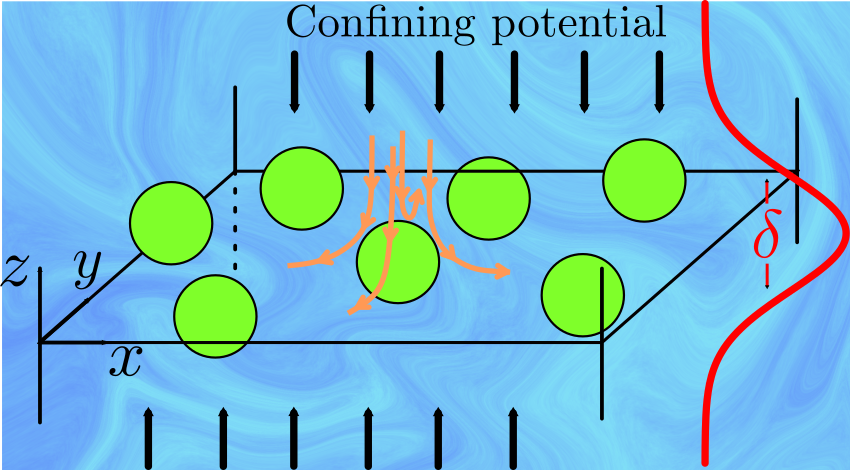
In the Quasi2D geometry, an incompressible fluid exists in a domain which is periodic in the plane and open in the third direction. The particles embedded in the fluid are able to move only in the plane directions, as if confined by an infinitely stiff potential in the third direction.
Thus, the Quasi2D solver (described in detail at [3] and in Raul’s manuscript) can be defined only in the plane, with the effect of the fluid in third direction added in an implicit manner. Doing so means that the flow as seen in the plane appears to be compressible, resulting in the arising of an effective thermal drift term in the BDHI equation.
![\frac{d\vec{\ppos}_i}{dt} = \oper{J}_{\vec{\ppos}_i}\left[\tens{G}_{\qtd}\left(\oper{S}\vec{F} + \vec{\partial}\oper{S}(\kT)\right) + \vec{w}(\vec{\fpos}, t)\right].](../_images/math/386aca7d189409908a0d5c2d900d05ddd13a1ede.svg)
The Quasi2D algorithm is based on the Force Coupling Method and thus part of the computation is carried out in Fourier space. The key of the Quasi2D algorithm lies in the realization that in general the hydrodynamic kernel can be written in Fourier space as

A Gaussian is used for spreading, which allows to compute the thermal drift term by spreading at the positions of the particles using the known derivative of the Gaussian.
Finally, the fluctuations are cheaply computed by using

as

By choosing the functions  and
and  different regimes can be modeled. For instance, when using a Gaussian for spreading a quasi2D regime corresponds to
![g_{k}\left(K\right) & = \frac{1}{2K^3}\left[1-{\erf}\left(\frac{K}{\sqrt{\pi}}\right)\right]\exp\left(\frac{K^2}{\pi}\right)\\
f_{k}\left(K\right) & = \left(\frac{1}{2} - \frac{K^{2}}{\pi}\right)g_k(K) - \frac{1}{2\pi K^3},](../_images/math/89f085e5392dd39b22bc23fbc1331c4ec47f9bea.svg)
while a purely two dimensional fluid, denoted as true2D, in which both fluid and particles exist in a two dimensions, corresponds to

The general framework to obtain these functions consists of preconvolving analytically the third direction in the three dimensional Greens function, by defining

which requires knowing the analytic expression of the spreading kernel and is the reason why a Gaussian is used in the current implementation.
UAMMD’s implementation abstracts away the and functions, which can be provided as a template parameter via a functor of the following form:
-
class Quasi2DHydrodynamicKernel
A class with arbitrary name that will be used the BDHI2D Integrator with the
and functions.-
bool hasThermalDrift();
Must return true if the thermal drift term should be included (it is zero in the true2D case, for instance).
-
bool hasThermalDrift();
The name of this object must be provided as a template argument to the Quasi2D Integrator module, which is called BDHI::BDHI2D.
- The first lines of the source file
Integrator/Hydro/BDHI_quasi2D.cuhcontain the currently implemented ones, which to this day are: True2D: Available as an alias
BDHI::True2DQuasi2D: Available as an alias
BDHI::Quasi2D
Usage
Use as the rest of the Integrator modules.
- The following parameters are available:
real temperatureTemperature of the solvent in units of energy. This is in the formulas.real viscosityViscosity of the solvent.real hydrodynamicRadiusHydrodynamic radius of the particles (same for all particles)real dtTime stepreal toleranceControls how fine the grid is and the support of the Gaussian spreading kernel.Box boxABoxwith the domain size information (third direction is ignored).shared_ptr<HydrodynamicKernel> hydroKernelAn instance of the hydrodynamic kernel can be passed. Allowing for it to hold a state (which can be modified between steps, for instance).
 #include<uammd.cuh>
 #include<Integrator/Hydro/BDHI_quasi2D.cuh>
 using namespace uammd;
 //A function that creates and returns a quasi 2D integrator
 auto createIntegratorQ2D(UAMMD sim){
   //Choose the hydrodynamic kernel
   using Hydro2D = BDHI::Quasi2D;
   //using Hydro2D = BDHI::True2D;
   //using Hydro2D = BDHI::BDHI2D<YourOwnHydrodynamicKernel>;
   Hydro2D::Parameters par;
   par.temperature = sim.par.temperature;
   par.viscosity = sim.par.viscosity;
   par.hydrodynamicRadius = sim.par.hydrodynamicRadius;
   par.dt = sim.par.dt;
   par.tolerance = sim.par.tolerance;
   par.box = sim.par.box;
   //par.hydroKernel = std::make_shared<YourOwnHydrodynamicKernel>(/*any parameters*/);
   auto q2d = std::make_shared<Hydro2D>(sim.pd, par);
   return q2d;
}
Doubly Periodic Stokes (DPStokes)
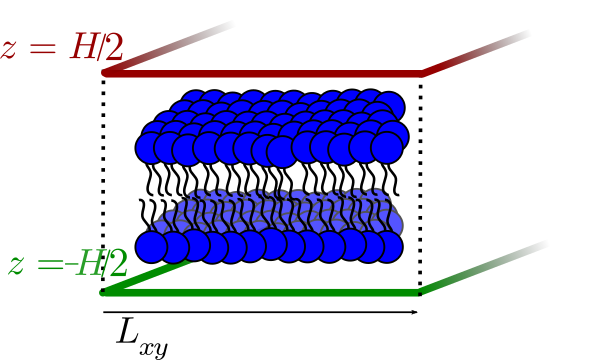
In the Doubly periodic Stokes geometry (DPStokes), an incompressible fluid exists in a domain which is periodic in the plane and open in the third direction. Contrary to the Quasi2D regime, in DPStokes particles are free to move in any direction (i.e. they are not confined to a plane).
The DPStokes solver (described in detail in Raul’s manuscript [1]) distinguishes between three different regimes:
Fully open: the fluid is bounded at infinity.
A no-slip wall at the bottom of the domain.
A no-slip wall at top and bottom (slit channel).
When there are no walls, a virtual domain size exists in the z direction that must contain all the force exerted by the particles to the fluid. A similar thing happens when there is a wall only at the bottom. In all cases, the domain in z is such that  .
.
The BM kernel (see IBM) is used for spreading and interpolating in this module. It can handle both particle forces and torques. The BM kernel is defined as:
![\phi_{BM}(r,\{\alpha, \beta, w\}) = \begin{cases} \frac{1}{S}\exp\left[\beta\left(\sqrt{1-(r/(h\alpha))^2}-1\right)\right] & |r|/(hw/2)\le 1 \\ 0 & \text{otherwise} \end{cases}](../_images/math/2f915f5225f7a627fdbf9f45c2d0abfe03555c60.svg)
where is the size of a grid cell in the plane.
Notes:
Typically one would set
 , however it can be useful to set them separately.
It can never happen that
 , since that would result in a complex number.
The width of the kernel (
 ) is related to the hydrodynamic kernel, while its support (
  ) and the size of a grid cell in the plane ( ) are set according to a certain tolerance.
There are some basic heuristics to choose the optimal parameters for the kernel depending on whether particle forces and torques or just forces are applied. The current implementation does not choose these automatically, so you must explicitly provide them.
Recommended parameters:
|
|


Additionally, the number of cells in the z direction is chosen such that the largest cell size is , which requires:

Currently there is no efficient way to compute fluctuations for BDHI, however, the Integrator includes them using the Lanczos algorithm. Testing shows that the hydrodynamic screening caused by the walls allows Lanczos to converge fast and independently of the number of particles.
Thermal drift must also be included (since the resulting mobility depends on the height), which is computed via Random Finite Differences.
The DPStokes solver comes in two different forms:
As an independent solver in the class DPStokesSlab_ns::DPStokes
As an Integrator (which uses the solver under the hood) in the class DPStokesSlab_ns::DPStokesIntegrator.
The solver can be used to compute the hydrodynamic displacements of a group of particles with some forces and/or torques acting on them, i.e applying the mobility operator.
The Integrator is able to carry out BDHI simulations by including fluctuations.
References
[1] R. P. Pelaez, Complex fluids in the GPU era. PhD thesis manuscript, 2022. URL: https://github.com/RaulPPelaez/tesis/raw/main/manuscript.pdf
-
class DPStokes
Implements a doubly periodic Stokes solver.
Public Functions
-
DPStokes(Parameters par)
Constructs a DPStokes object with the given parameters.
- Parameters:
par – The parameters for the DPStokes solver.
-
template<class PosIterator, class ForceIterator>
inline cached_vector<real3> Mdot(PosIterator pos, ForceIterator forces, int numberParticles, cudaStream_t st = 0) Computes the hydrodynamic displacements (velocities) resulting from the forces acting on a group of positions.
- Parameters:
pos – Iterator containing the positions of the particles.
forces – Iterator containing the forces acting on each particle.
numberParticles – The length of the input iterators.
st – CUDA stream to use for asynchronous operations.
- Template Parameters:
PosIterator – Type of the position iterator.
ForceIterator – Type of the force iterator.
- Returns:
A cached_vector containing the computed hydrodynamic displacements (velocities) for each particle.
-
template<class PosIterator, class ForceIterator, class TorqueIterator>
inline std::pair<cached_vector<real3>, cached_vector<real3>> Mdot(PosIterator pos, ForceIterator forces, TorqueIterator torques, int numberParticles, cudaStream_t st) Computes the linear and angular hydrodynamic displacements (velocities) coming from the forces and torques acting on a group of positions. If the torques pointer is null, the function will only compute and return the translational part of the mobility.
- Parameters:
pos – Iterator containing the positions of the particles.
forces – Iterator containing the forces acting on each particle.
torques – Iterator containing the torques acting on each particle.
numberParticles – The length of the input iterators.
st – CUDA stream to use for asynchronous operations.
- Template Parameters:
PosIterator – Type of the position iterator.
ForceIterator – Type of the force iterator.
TorqueIterator – Type of the torque iterator.
- Returns:
A pair of cached_vectors containing the computed hydrodynamic displacements (velocities) for each particle, and the angular velocities if torques are provided.
-
template<class PosIterator, class ForceIterator>
inline std::vector<double> computeAverageVelocity(PosIterator pos, ForceIterator forces, int numberParticles, int direction = 0, cudaStream_t st = 0) Computes the average velocity profile in the x or y direction as a function of z.
This function calculates the average velocity of particles along the specified direction (x or y) as a function of the z-coordinate. It does so by spreading the particle forces onto a grid, performing a Chebyshev transform, solving the boundary value problem for the fluid velocity, applying corrections if necessary, and then reconstructing the average velocity profile in real space using Chebyshev polynomial summation.
- Template Parameters:
PosIterator – Iterator type for particle positions.
ForceIterator – Iterator type for particle forces.
- Parameters:
pos – Iterator to the beginning of particle positions.
forces – Iterator to the beginning of particle forces.
numberParticles – Number of particles in the system.
direction – Direction in which to compute the average velocity: 0 for x (default), 1 for y.
st – CUDA stream to use for asynchronous operations (default: 0).
- Returns:
std::vector<double> Average velocity as a function of z (size: number of grid points in z).
-
struct Parameters
Parameters for the DPStokes solver. These are shared with DPStokesIntegrator.
Subclassed by uammd::DPStokesSlab_ns::DPStokesIntegrator::Parameters
Public Members
-
int nx
Number of grid points in the x direction.
-
int ny
Number of grid points in the y direction.
-
int nz = -1
Number of grid points in the z direction, -1 means that it will be autocomputed if not present
-
real3 beta = {-1.0, -1.0, -1.0}
Width of the monopole kernel function in each direction. At least X should be set.
-
int nx
-
DPStokes(Parameters par)
-
class DPStokesIntegrator : public uammd::Integrator
A wrapper class exposing DPStokes as an Integrator.
Public Functions
Construct a new DPStokesIntegrator.
- Parameters:
pd – Particle data instance
par – Parameters for the integrator
-
inline virtual void forwardTime()
Advance the simulation by one time step.
-
struct Parameters : public uammd::DPStokesSlab_ns::DPStokes::Parameters
Parameters for the DPStokesIntegrator. This class needs all the DPStokes parameters, plus the ones in this struct.
 .
. -
enum class uammd::DPStokesSlab_ns::WallMode
Specifies the mode of wall configuration in the simulation.
Values:
-
enumerator bottom
Only the bottom wall is present.
-
enumerator slit
Both top and bottom walls are present, forming a slit.
-
enumerator none
No walls are present.
-
enumerator bottom
Warning
Both the solver and Integrator will fail if some particle lies beyond the domain limits in the z direction.
References: